


S2K Commerce - Products Dropdown
Actions
Web Content Viewer
Actions
Marine Wire & Battery Cable Size Chart: ABYC Color Codes + Voltage Drop Guide (2026)
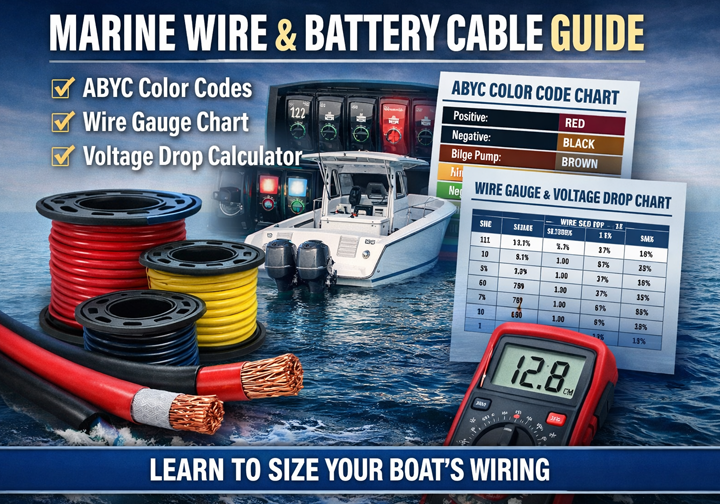
Marine Wire & Battery Cable Size Chart, ABYC Color Codes & Voltage Drop Guide (2026)
Whether you’re installing battery cables for engine starting and charging, or running marine wire for pumps, lights, electronics, and accessories, choosing the correct wire size and using consistent color coding is critical for safety, performance, and easier troubleshooting.
Marine Wire vs Battery Cable (What’s the Difference?)
In everyday boating, people often say “wire” for everything. Technically, battery cable is a heavy-gauge conductor used for high-current loads (engine starting, charging, inverters), while marine primary wire covers most accessory circuits (pumps, lights, electronics, switches).
| Type | Typical Sizes | Common Uses | What to Look For |
|---|---|---|---|
| Marine Primary Wire | 18 AWG to 6 AWG (commonly) | Lights, pumps, electronics, accessories, switch panels | Tinned copper, flexible stranded, marine-rated insulation |
| Marine Battery Cable | 6 AWG to 4/0 AWG | Engine starting, alternator charging, battery banks, inverters | Tinned copper, very fine strands, heavy-duty insulation, correct lugs |
ABYC Marine Wire Color Code Chart
ABYC wiring color conventions help keep DC systems consistent and safer to troubleshoot. Many newer boats use yellow for DC negative to reduce confusion with AC wiring.
| Function | Common ABYC Color | Notes |
|---|---|---|
| DC Positive (battery feed) | Red | Used for battery positive and DC positive feeds. |
| DC Negative (modern standard) | Yellow | Recommended on many newer boats to avoid confusion with AC wiring. |
| DC Negative (legacy) | Black | Common on older boats; avoid mixing black and yellow negatives unless clearly labeled. |
| Bonding | Green or Green/Yellow | Used for bonding conductors (not the same as DC negative). |
| Ignition / switched engine power | Purple | Often used as an ignition-switched feed. |
| Bilge pump | Brown | May appear as brown with stripe depending on manufacturer. |
| Cabin / interior lighting | Blue | Often blue (and light blue for instrument/panel lighting). |
| Fuel sender | Pink | Typically reserved for fuel tank sending unit circuits. |
Marine Wire Gauge Ampacity Chart (Quick Reference)
Ampacity is the maximum current a wire can safely carry without overheating (based on insulation rating, environment, and installation). In marine systems, voltage drop often determines wire size before ampacity, especially on longer runs.
| Size | Typical Ampacity (Engine Space) | Common Use | More Like… |
|---|---|---|---|
| 16 AWG | ~18A | Small electronics, low-current accessories | Marine wire |
| 14 AWG | ~25A | Lighting circuits, small pumps | Marine wire |
| 12 AWG | ~30A | Accessory feeds, moderate pumps | Marine wire |
| 10 AWG | ~40A | Larger pumps, windlass control circuits, charging feeds (small) | Marine wire |
| 8 AWG | ~55A | High loads, short runs, some trolling motor wiring | Borderline / small cable |
| 6 AWG | ~75A | Trolling motors, charging circuits, modest inverter feeds | Small battery cable |
| 4 AWG | ~95A | Battery banks, mid-size outboards (short runs) | Battery cable |
| 2 AWG | ~130A | Starting/charging for larger engines | Battery cable |
| 1/0 AWG | ~170A | Engine starting circuits (common) | Battery cable |
| 2/0 AWG | ~195A | Larger outboards, longer runs | Battery cable |
| 4/0 AWG | ~260A | High-current systems, very long runs, large banks/inverters | Battery cable |
Voltage Drop Basics (Why Wire Size Matters)
Voltage drop is the loss of voltage caused by resistance in the conductor. In boats, long runs, vibration, and corrosion can make voltage drop even more important than in automotive applications.
- Too much voltage drop can cause hard starting, low charging performance, ECU alarms, dim lights, and pump issues.
- Use 3% maximum voltage drop for critical circuits (electronics, bilge pumps, navigation, and most battery/starting circuits).
- Use 10% maximum for non-critical loads (some lighting and general accessories), when appropriate.
12V System – 3% Voltage Drop Wire & Cable Size Chart
Use this chart to choose wire size based on current draw and total (round-trip) length. This applies to battery cables (high current) and any critical marine wire runs where you want to keep voltage drop low. When in doubt, choose the next size larger.
| Current (Amps) | 10 ft total run | 20 ft total run | 30 ft total run |
|---|---|---|---|
| 50A | 6 AWG | 4 AWG | 2 AWG |
| 100A | 2 AWG | 1/0 AWG | 2/0 AWG |
| 150A | 1/0 AWG | 2/0 AWG | 4/0 AWG |
| 200A | 2/0 AWG | 4/0 AWG | 4/0 AWG |
Interactive Marine Voltage Drop Calculator (12V)
Enter your amps and total (round-trip) length, then select a wire size to estimate voltage drop. This is a planning tool for both marine wire and battery cables—always verify final sizing for your installation.
Best Practices (Wire Runs & Battery Cables)
- Use marine-grade tinned copper wire/cable for corrosion resistance and flexibility.
- Protect circuits correctly: use appropriate fuses/breakers and proper distribution points.
- Route smart: avoid sharp edges, heat sources, moving parts, and fuel lines when possible.
- Support runs: secure wiring to prevent vibration fatigue and chafe.
- Use sealed terminations: adhesive-lined heat shrink helps block moisture intrusion.
- Battery cable terminations: use correct lugs and a quality crimper (hex/hydraulic recommended).
- Label both ends of every circuit for easier troubleshooting later.
- Avoid automotive wire—it corrodes quickly in marine environments.
Common Marine Circuits & Typical Wire Sizes
These are typical starting points for marine primary wire. Always confirm with your fuse size, load current, and voltage drop (especially on longer runs).
| Circuit | Typical Current | Common Starting Wire Size | Notes |
|---|---|---|---|
| LED nav / anchor lights | 1–3A | 16–14 AWG | Long runs may benefit from larger wire for brightness/voltage stability. |
| Livewell / washdown pump | 5–15A | 14–12 AWG | Size by pump draw and distance; consider 3% for critical pumping. |
| Bilge pump (automatic) | 3–15A | 14–12 AWG | Often treated as critical; aim for low voltage drop. |
| Electronics feed (plotter / sonar) | 2–10A | 14–12 AWG | Low drop helps prevent resets and noise issues. |
| Trolling motor (12V/24V/36V) | 30–60A+ | 8–4 AWG (often larger) | Trolling motors are very sensitive to voltage drop on long runs. |
Quick Battery Cable Selector (by Engine HP)
This is a quick starting point for engine starting battery cables. Always confirm with round-trip length and voltage drop.
| Engine HP | Under 10 ft (round trip) | 10–20 ft (round trip) |
|---|---|---|
| Under 150 HP | 4 AWG | 2 AWG |
| 150–250 HP | 2 AWG | 1/0 AWG |
| 250–350 HP | 1/0 AWG | 2/0 AWG |
| 350+ HP | 2/0 AWG | 4/0 AWG |
Shop Marine Wire, Battery Cable & Components
Looking for marine-grade tinned copper primary wire, battery cable, lugs, heat shrink, or custom assemblies? Use the links below to shop by category. (Update these URLs to your exact ProMarineUSA category/product pages.)
Tinned copper wire for pumps, lights, and electronics. Marine Battery Cable (All Sizes)
Heavy-gauge tinned copper cable for starting & charging. Battery Lugs (Tinned Copper)
Heavy-duty lugs for 6 AWG–4/0 AWG cable. Adhesive Heat Shrink
Seal terminations to resist saltwater corrosion. Custom Battery Cables
Made-to-length marine battery cable assemblies.
Frequently Asked Questions
What size wire should I use for marine accessories?
It depends on current draw and length. Many small loads use 16–12 AWG, but longer runs and critical circuits often need larger wire to keep voltage drop low. Use the calculator above for a quick estimate.
What size battery cable do I need for a 200 HP outboard?
Common starting points are 2 AWG for shorter runs and 1/0 AWG as length increases. Always verify using total (round-trip) length and a 3% voltage drop target.
What is the ABYC standard color for DC negative?
Many modern marine wiring conventions use yellow for DC negative to reduce confusion with AC wiring. Older boats often use black as DC negative.
How do I measure wire length correctly?
Measure the route from the power source to the load, then include the return path for round-trip length (positive + negative).
Is marine wire different than automotive wire?
Yes. Marine wire is typically tinned copper, fine-stranded for flexibility, and uses insulation designed to resist heat, oil, and moisture—helping prevent corrosion in saltwater environments.
What voltage drop is acceptable on a boat?
A common best practice is 3% maximum for critical circuits and many starting circuits, and up to 10% for some non-critical loads depending on the equipment and application.